



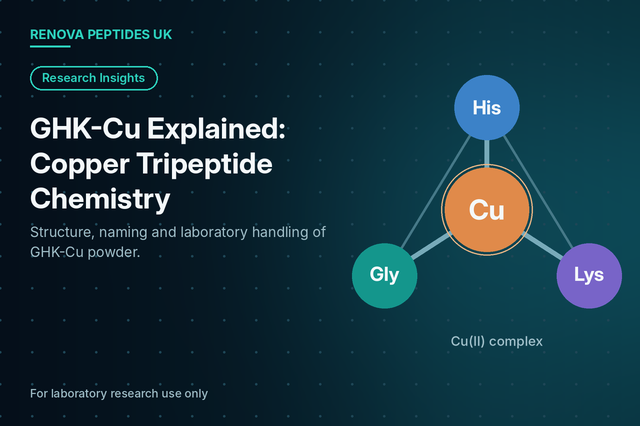
GHK-Cu is a copper(II) complex of the tripeptide glycyl-L-histidyl-L-lysine (Gly-His-Lys). It is one of the most widely studied copper peptides in research literature, and it is supplied as a lyophilised GHK-Cu powder for laboratory use. This guide explains its structure, naming, and the handling points that matter for research teams in the UK.
What is GHK-Cu?
GHK is a short peptide made of three amino acids: glycine, histidine and lysine. On its own, the peptide has a molecular weight of roughly 340 g/mol. When it binds a copper(II) ion, it forms the GHK-Cu complex. The peptide was first isolated from human plasma and described in the early 1970s, and it has been studied in laboratory research ever since.
What is the difference between GHK and GHK-Cu?
| GHK | GHK-Cu | |
|---|---|---|
| Composition | Gly-His-Lys tripeptide | GHK bound to copper(II) |
| Common names | Tripeptide | Copper peptide, copper tripeptide, copper tripeptide-1 |
| Appearance in solution | Colourless | Blue to violet, because of the copper complex |
| Research use | Peptide chemistry studies | Studies involving metal-peptide complexes |
The copper binds mainly through the histidine side chain and nearby nitrogen atoms of the peptide backbone. This is why the complex shows its characteristic blue colour.
Why do you see so many names for the same compound?
The names “copper peptide”, “copper tripeptide” and “copper tripeptide-1” usually refer to the same GHK-Cu complex. “Copper tripeptide-1” is also the name used in cosmetic ingredient lists. Renova Peptides supplies GHK-Cu strictly for laboratory research, not for cosmetic, human or veterinary use. For more on how peptides are named, see our guide to peptide nomenclature, sequences and molecular weight.
How should GHK-Cu powder be stored in a laboratory?
GHK-Cu is supplied as a lyophilised (freeze-dried) powder, which is more stable than a solution. Standard laboratory practice includes:
- Keep vials sealed, dry and protected from light.
- Store lyophilised material cold, following the supplier’s storage guidance.
- Let the vial reach room temperature before opening to avoid condensation.
- Record the batch number and date of first opening.
Our guides to lyophilised peptides and laboratory storage and handling explain these points in more detail.
How can researchers check the quality of GHK-Cu powder?
- Request the certificate of analysis for the specific batch. See how to read a COA.
- Check HPLC purity and confirm identity by mass spectrometry. See HPLC vs mass spectrometry.
- Remember that purity and peptide content are different measures. See purity vs content.
- Confirm the product is clearly labelled research use only.
Frequently asked questions
Is copper peptide the same as GHK-Cu? In most cases, yes. “Copper peptide” usually means the GHK-Cu complex, although other copper-binding peptides exist.
Why is GHK-Cu blue? The blue to violet colour comes from the copper(II) ion bound to the peptide.
Is GHK-Cu powder soluble in water? It is generally water soluble. Solvent choice and sterile technique are covered in our reconstitution guide.
Is GHK-Cu available in the UK for research? Yes. Renova Peptides supplies GHK-Cu 50mg/100mg for laboratory research use only, not for human or veterinary use.
For laboratory research use only. Not for human or veterinary use.