



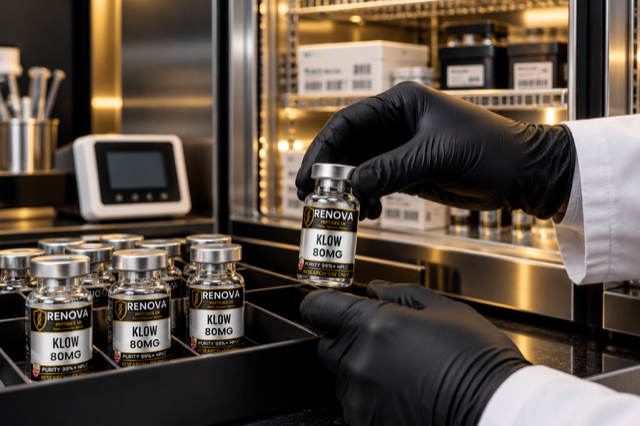
Quick answer: Lyophilisation, also called freeze-drying, removes water from a compound by freezing it and then reducing the surrounding pressure so the ice turns directly into vapour. This leaves a stable, dry powder that is far less vulnerable to degradation, which is why many research peptides are supplied in lyophilised form.
What does lyophilised mean?
Lyophilised means freeze-dried. The term describes a compound that has been frozen and then dried under vacuum, a process known as sublimation. The result is usually a light, white powder or “cake” in the vial.
How does the lyophilisation process work?
Freezing: the solution is cooled until it solidifies.
Primary drying: under vacuum, frozen water sublimates directly into vapour.
Secondary drying: remaining bound moisture is gently removed.
Because the compound is never exposed to high heat, its structure is better preserved than with conventional drying.
Why is lyophilisation used for research peptides?
Water drives many degradation pathways, including hydrolysis. By removing most of the moisture, lyophilisation:
Improves long-term stability
Extends shelf life
Makes transportation and storage more reliable
Helps maintain batch consistency over time
How should lyophilised compounds be stored in the laboratory?
General laboratory practice includes:
Keep them cold and dry: long-term storage in a freezer is common, following the supplier’s documentation.
Protect from light: store vials in their original packaging or in the dark.
Avoid moisture: lyophilised powders can absorb water from the air.
Let vials reach room temperature before opening: this prevents condensation forming inside the vial.
Minimise repeated opening: each exposure to air and humidity can affect stability.
Label and log everything: record batch numbers, dates and storage conditions.
For wider guidance, see our article on best practices for laboratory storage and handling.
What affects stability after lyophilisation?
The main factors are temperature, humidity, light exposure, container quality and handling frequency. Sealed, properly stored vials remain far more stable than those exposed to fluctuating conditions. Once a compound is placed into solution, its stability generally drops, so any solution handling should follow the supplier’s documentation and your laboratory’s own protocols.
How can researchers confirm quality?
Check the batch-specific Certificate of Analysis, inspect the vial for an intact seal and an appropriate appearance, and record the condition on arrival.
FAQs
Why are research peptides supplied as a powder?
The lyophilised form is more stable than a solution, which improves shelf life and transport reliability.
What is a lyophilised “cake”?
It is the porous, dry solid left in the vial after freeze-drying.
Why allow a vial to warm before opening it?
Opening a cold vial can draw in moisture from the air, which may compromise stability.
All products are supplied strictly for laboratory research purposes only and are not intended for human or veterinary use.