



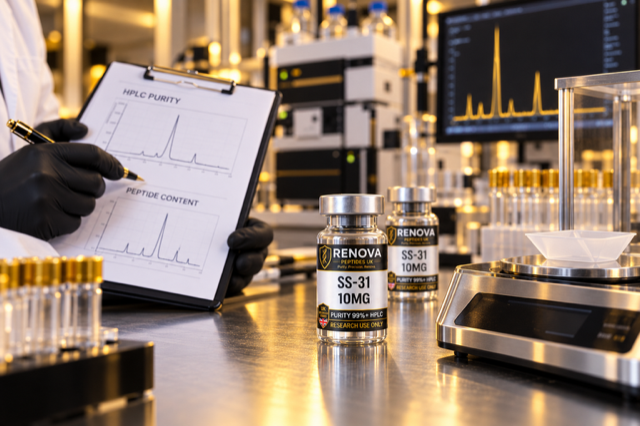
Quick answer: Peptide purity, usually measured by HPLC, shows what percentage of the peptide material is the target sequence rather than related peptide impurities. Net peptide content shows how much of the powder in the vial is peptide at all, as opposed to water, salts and counter-ions. A vial can be 99% pure and still contain well under 100% peptide by weight.
Researchers comparing suppliers often focus on one number: the purity percentage. It is an important figure, but it answers only one question. This guide explains what purity and peptide content each measure, why they differ, and how to use both when planning laboratory work.
What does peptide purity mean?
Purity is most often reported from reversed-phase HPLC. The instrument separates the components of a sample, and a detector (commonly set at 214 to 220 nm, where peptide bonds absorb light) records each one as a peak. Purity is the area of the main peak divided by the total area of all peaks.
The impurities counted here are peptide-related: truncated sequences, deletion sequences, incompletely deprotected products and oxidised forms created during synthesis or storage. A purity of 99% means that, of the peptide-related material detected, 99% is the target sequence.
What is net peptide content?
A lyophilised peptide powder is not pure peptide. It also contains:
- Residual water, because lyophilised peptides are hygroscopic
- Counter-ions, such as trifluoroacetate (TFA) or acetate, bound to charged amino acid side chains
- Residual salts from purification and handling
Net peptide content is the proportion of the powder, by weight, that is actually peptide. It is typically determined by amino acid analysis or elemental nitrogen analysis. Values commonly fall between roughly 70% and 90%, depending on the sequence length, the number of charged residues and the counter-ion used.
How can a peptide be 99% pure but only 80% peptide?
The two figures measure different things. Purity compares the peptide to its own impurities. Net content compares the peptide to everything else in the vial.
For example, a 10 mg vial with 80% net peptide content holds about 8 mg of peptide. If that peptide is 99% pure by HPLC, roughly 7.9 mg is the target sequence. The remaining 2 mg is water, counter-ions and salts. Both numbers are correct, and both matter.
Why do counter-ions matter?
Peptides purified by HPLC are often isolated as TFA salts, because TFA is common in the mobile phase. Acetate or hydrochloride forms are also available. Counter-ions add weight, can influence solubility, and have been reported to interfere with some cell-based assays. If your experimental design is sensitive to this, check which salt form a batch uses.
What should you look for on a certificate of analysis?
A useful COA should state:
- HPLC purity percentage, with the method and detection wavelength
- Mass spectrometry confirmation of molecular weight
- Batch or lot number
- Net peptide content or water content, where tested
- Counter-ion or salt form, where known
For a full walkthrough, see our guide on how to read a Certificate of Analysis and our comparison of HPLC vs mass spectrometry.
Practical tips for researchers
- Calculate concentrations from net content when precision matters, rather than from gross vial weight.
- Compare like with like. Purity figures from different HPLC methods or wavelengths are not directly comparable.
- Ask for net content data when a COA does not include it.
- Record batch numbers so results can be traced. Our article on batch traceability explains why this protects data quality.
Frequently asked questions
Does 99% purity mean the vial contains 99% peptide? No. Purity describes the target peptide relative to peptide-related impurities. The vial also contains water, counter-ions and salts, so net peptide content is lower.
Is higher purity always better? Not always. The required purity depends on the experimental design. Many research applications specify 95% or higher, but the right choice depends on the assay and how sensitive it is to impurities.
How is net peptide content measured? Usually by amino acid analysis or elemental nitrogen analysis, which determine how much of the powder is peptide by weight.
Disclaimer: This article is for general informational and educational purposes only. All products are supplied strictly for laboratory research use only and are not intended for human or veterinary use.
Suggested internal links: How To Read A Certificate Of Analysis; HPLC vs Mass Spectrometry; What Defines A Research-Grade Compound.