



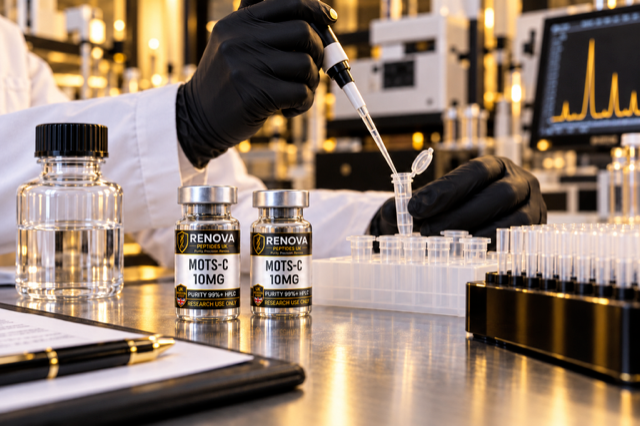
Quick answer: In a laboratory, reconstitution means dissolving a lyophilised peptide in a suitable solvent to make a stock solution. The right solvent depends on the peptide’s amino acid composition and the downstream assay. Good practice includes aseptic technique, gentle mixing, accurate labelling, aliquoting and minimising freeze-thaw cycles.
A peptide that is handled well on arrival can still be compromised at the bench. Reconstitution is one of the steps where contamination, degradation and calculation errors most often creep in. This article covers general laboratory practice for preparing stock solutions from lyophilised material.
Why does reconstitution technique matter?
Once a peptide is in solution it is far less stable than the lyophilised powder. It is exposed to microbial growth, oxidation, adsorption to plastic and hydrolysis. Careful preparation protects both the peptide and the reliability of the data you generate from it. For background on the powder itself, see our guide to lyophilised peptides.
How do you choose a solvent?
There is no single solvent for every peptide. A common approach is to look at the sequence and net charge:
- Basic peptides (rich in lysine, arginine, histidine) often dissolve in sterile ultra-pure water, and a dilute acid such as acetic acid can help if they do not.
- Acidic peptides (rich in aspartic or glutamic acid) may dissolve better in a slightly basic buffer.
- Hydrophobic or neutral peptides may need a small volume of an organic solvent such as DMSO first, then gradual dilution with an aqueous buffer.
Start with a small test portion where possible, and always confirm that the solvent is compatible with your assay. Some additives interfere with experiments, so check this before preparing a full stock.
Sterile water, bacteriostatic water or buffer?
Sterile, ultra-pure or nuclease-free water is a common default for laboratory stock solutions. Bacteriostatic water contains a preservative, typically 0.9% benzyl alcohol, which limits microbial growth in multi-use vials but may not suit every experimental system, particularly sensitive cell-based work. Buffers such as PBS suit some peptides but can cause others to precipitate. Choose according to the peptide and the assay, and record what you used.
Step-by-step laboratory practice
- Equilibrate the vial. Let the sealed vial reach room temperature before opening so condensation does not introduce moisture.
- Prepare a clean workspace. Work in a laminar flow cabinet or a clean, disinfected area, with gloves and sterile consumables.
- Wipe the vial stopper with an appropriate disinfectant and let it dry.
- Add solvent slowly, directing it down the inside wall of the vial rather than onto the powder.
- Mix gently. Swirl or roll the vial. Vigorous shaking can cause foaming, aggregation and loss of material.
- Check the solution. It should be clear. Cloudiness or particles suggest solubility problems.
- Filter if required. A 0.22 micron filter can remove contaminants, but some peptides adsorb to filter membranes, so use low-binding materials.
Aliquoting, labelling and storage
Repeated freeze-thaw cycles damage peptides, so divide the stock into single-use aliquots in low-binding tubes. Label every tube with:
- Peptide name and batch number
- Solvent and final concentration
- Date of preparation
- Preparer’s initials
Store aliquots at the temperature recommended for your peptide, commonly -20 °C or colder, and protect them from light where relevant. Our guide to laboratory storage and handling covers conditions in more detail.
Common mistakes to avoid
- Calculating concentration from gross powder weight instead of net peptide content (see our article on purity vs peptide content)
- Shaking the vial vigorously
- Reusing a thawed aliquot repeatedly
- Failing to record solvent, date and batch
- Using non-sterile pipette tips or tubes
Frequently asked questions
What is the best solvent for reconstituting a peptide? It depends on the sequence and the assay. Basic peptides often dissolve in sterile water or dilute acid, while hydrophobic peptides may need a small amount of DMSO before dilution.
Why should peptide stock solutions be aliquoted? Aliquoting avoids repeated freeze-thaw cycles, which can degrade peptides, and reduces contamination risk from repeated access to one container.
Can a reconstituted peptide be stored long term? Solutions are generally less stable than lyophilised powder. Store aliquots frozen, use them within a defined period, and follow the stability guidance for your specific peptide.
Disclaimer: This article describes general laboratory practice for in-vitro research only. All products are supplied strictly for laboratory research use only and are not intended for human or veterinary use.