



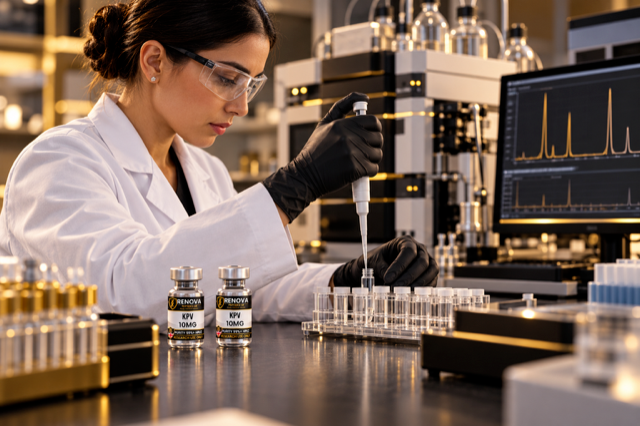
Quick answer: HPLC (High-Performance Liquid Chromatography) measures the purity of a sample by separating its components. Mass spectrometry confirms identity by measuring molecular weight. Research laboratories use both together, because purity alone does not prove identity, and identity alone does not prove purity.
What is HPLC?
HPLC is an analytical technique that separates a sample into its individual components as it passes through a column under pressure. A detector records each component as a peak on a chromatogram. The area of the main peak, compared with the total area of all peaks, is used to calculate a purity percentage.
What is mass spectrometry?
Mass spectrometry (MS) measures the mass-to-charge ratio of ionised molecules. For research compounds, it confirms that the molecular weight of the sample matches the expected value. This verifies that the compound is what it is supposed to be.
What is the difference between HPLC and mass spectrometry?
| Feature | HPLC | Mass Spectrometry |
|---|---|---|
| Main purpose | Measures purity | Confirms identity |
| What it reports | Percentage of main peak vs impurities | Molecular weight |
| Output | Chromatogram | Mass spectrum |
| Limitation | Cannot confirm identity on its own | Not a precise measure of purity |
Why do laboratories use both methods?
Each method answers a different question. HPLC answers, “How pure is this sample?” Mass spectrometry answers, “Is this the correct compound?” A sample could appear highly pure by HPLC and still be the wrong molecule, which is why combined testing gives a far more reliable picture.
What does “99% purity” actually mean?
A figure such as 99% purity usually means that the main peak accounts for roughly 99% of the total detected peak area in an HPLC analysis. It does not, on its own, tell you:
Whether the compound’s identity has been confirmed
Which method settings were used
Whether the result applies to your specific batch
Whether water or counter-ion content has been accounted for
This is why purity claims should always be backed by a batch-specific COA and the underlying data. Our guide on how to read a Certificate of Analysis explains how to check this.
How should researchers use this information?
When reviewing a compound, look for both an HPLC chromatogram and a mass spectrum, confirm they carry the same batch number, and check that the testing date and laboratory are stated. Consistent documentation supports batch traceability and reproducible results.
FAQs
Which is more important, HPLC or mass spectrometry?
Neither replaces the other. HPLC verifies purity and MS verifies identity, so both are needed.
Can a sample be 99% pure by HPLC and still be incorrect?
Yes. HPLC does not confirm identity, which is why mass spectrometry is used alongside it.
Does HPLC purity include water content?
Not usually. HPLC reports relative peak purity, which differs from net content.
All products are supplied strictly for laboratory research purposes only and are not intended for human or veterinary use.