



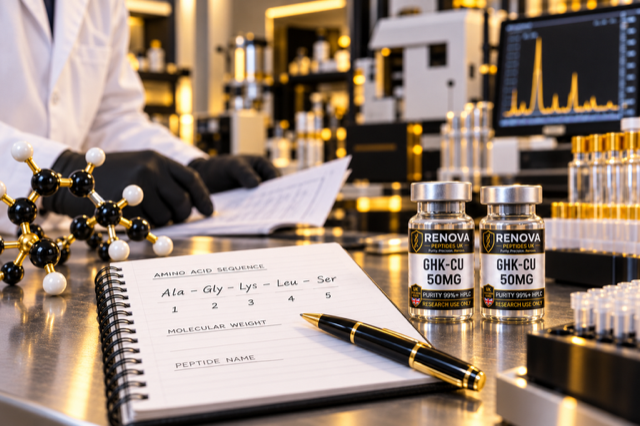
Quick answer: A peptide is named and described by its amino acid sequence, written from the N-terminus to the C-terminus using three-letter or one-letter codes. Its molecular weight is the sum of its residue masses plus one water molecule, and modifications such as acetylation or amidation are written as prefixes or suffixes. Reading these correctly lets you verify a product against its certificate of analysis.
Peptide documentation can look like a code. Product names, sequences, molecular weights and CAS numbers all describe the same molecule in different ways. This guide explains the conventions so you can read specifications and COAs with confidence.
How are peptide sequences written?
Sequences are written from the N-terminus (the free amino end) on the left to the C-terminus (the free carboxyl end) on the right. Each amino acid has a three-letter and a one-letter code:
- Glycine: Gly, G
- Alanine: Ala, A
- Lysine: Lys, K
- Phenylalanine: Phe, F
- Cysteine: Cys, C
A short example sequence written in three-letter form is Gly-Ala-Lys-Phe. The one-letter form is GAKF. Longer peptides are almost always written in one-letter code for readability.
What do prefixes and suffixes mean?
Chemical modifications are shown at the ends of the sequence:
- Ac- at the start indicates N-terminal acetylation.
- -NH2 at the end indicates C-terminal amidation, which replaces the carboxyl group.
- cyclo- or a bracket notation indicates a cyclic structure.
- A lowercase letter or a “D-” prefix indicates a D-amino acid rather than the natural L-form.
- Disulfide labels indicate bonds formed between cysteine residues.
These details change the molecular weight and often the stability of the compound, so the exact notation on a specification sheet matters.
How is molecular weight calculated?
The average molecular weight is the sum of the masses of each amino acid residue plus one molecule of water (about 18.015 Da) for the free termini. Each modification then adds or removes mass. For instance, N-terminal acetylation adds roughly 42 Da, and amidation reduces the mass by about 1 Da.
Two values are commonly quoted:
- Average mass, which uses the average isotopic abundance of each element
- Monoisotopic mass, which uses the most abundant isotope of each element and is what high-resolution mass spectrometry typically reports
Knowing which one a document uses avoids apparent mismatches.
Why molecular weight on a COA matters
Mass spectrometry confirms that the molecule in the vial has the expected mass. If the measured value does not match the theoretical value calculated from the sequence and modifications, something is wrong: a different sequence, a missing modification or a degradation product. Our guide to HPLC vs mass spectrometry explains how the two tests complement each other, and our walkthrough of the certificate of analysis shows where to find these values.
Names, CAS numbers and identifiers
One compound can appear under several identifiers:
- Common or research name, which may vary between suppliers
- Systematic or sequence-based name, which is unambiguous
- CAS Registry Number, a unique numerical identifier for a chemical substance
- Molecular formula, which lists the atoms present
When comparing suppliers, the sequence and CAS number are more reliable than a trade or shorthand name.
A short checklist for reading specifications
- Confirm the full sequence and its direction (N to C).
- Check for terminal modifications such as Ac- or -NH2.
- Compare the theoretical molecular weight with the mass spectrometry result.
- Check the salt form and net peptide content (see purity vs peptide content).
- Match the batch number on the vial to the COA.
Frequently asked questions
What do the letters in a peptide sequence mean? Each letter is the one-letter code for an amino acid, for example G for glycine and K for lysine. The order of the letters is the order of the amino acids from N-terminus to C-terminus.
What is the difference between average and monoisotopic mass? Average mass uses the natural average of isotopes, while monoisotopic mass uses the most abundant isotope of each element. High-resolution mass spectrometry usually reports monoisotopic values.
Why does the molecular weight include water? WQuick answer: A peptide is named and described by its amino acid sequence, written from the N-terminus to the C-terminus using three-letter or one-letter codes. Its molecular weight is the sum of its residue masses plus one water molecule, and modifications such as acetylation or amidation are written as prefixes or suffixes. Reading these correctly lets you verify a product against its certificate of analysis.
Peptide documentation can look like a code. Product names, sequences, molecular weights and CAS numbers all describe the same molecule in different ways. This guide explains the conventions so you can read specifications and COAs with confidence.
How are peptide sequences written?
Sequences are written from the N-terminus (the free amino end) on the left to the C-terminus (the free carboxyl end) on the right. Each amino acid has a three-letter and a one-letter code:
- Glycine: Gly, G
- Alanine: Ala, A
- Lysine: Lys, K
- Phenylalanine: Phe, F
- Cysteine: Cys, C
A short example sequence written in three-letter form is Gly-Ala-Lys-Phe. The one-letter form is GAKF. Longer peptides are almost always written in one-letter code for readability.
What do prefixes and suffixes mean?
Chemical modifications are shown at the ends of the sequence:
- Ac- at the start indicates N-terminal acetylation.
- -NH2 at the end indicates C-terminal amidation, which replaces the carboxyl group.
- cyclo- or a bracket notation indicates a cyclic structure.
- A lowercase letter or a “D-” prefix indicates a D-amino acid rather than the natural L-form.
- Disulfide labels indicate bonds formed between cysteine residues.
These details change the molecular weight and often the stability of the compound, so the exact notation on a specification sheet matters.
How is molecular weight calculated?
The average molecular weight is the sum of the masses of each amino acid residue plus one molecule of water (about 18.015 Da) for the free termini. Each modification then adds or removes mass. For instance, N-terminal acetylation adds roughly 42 Da, and amidation reduces the mass by about 1 Da.
Two values are commonly quoted:
- Average mass, which uses the average isotopic abundance of each element
- Monoisotopic mass, which uses the most abundant isotope of each element and is what high-resolution mass spectrometry typically reports
Knowing which one a document uses avoids apparent mismatches.
Why molecular weight on a COA matters
Mass spectrometry confirms that the molecule in the vial has the expected mass. If the measured value does not match the theoretical value calculated from the sequence and modifications, something is wrong: a different sequence, a missing modification or a degradation product. Our guide to HPLC vs mass spectrometry explains how the two tests complement each other, and our walkthrough of the certificate of analysis shows where to find these values.
Names, CAS numbers and identifiers
One compound can appear under several identifiers:
- Common or research name, which may vary between suppliers
- Systematic or sequence-based name, which is unambiguous
- CAS Registry Number, a unique numerical identifier for a chemical substance
- Molecular formula, which lists the atoms present
When comparing suppliers, the sequence and CAS number are more reliable than a trade or shorthand name.
A short checklist for reading specifications
- Confirm the full sequence and its direction (N to C).
- Check for terminal modifications such as Ac- or -NH2.
- Compare the theoretical molecular weight with the mass spectrometry result.
- Check the salt form and net peptide content (see purity vs peptide content).
- Match the batch number on the vial to the COA.
Frequently asked questions
What do the letters in a peptide sequence mean? Each letter is the one-letter code for an amino acid, for example G for glycine and K for lysine. The order of the letters is the order of the amino acids from N-terminus to C-terminus.
What is the difference between average and monoisotopic mass? Average mass uses the natural average of isotopes, while monoisotopic mass uses the most abundant isotope of each element. High-resolution mass spectrometry usually reports monoisotopic values.
Why does the molecular weight include water? When amino acids join, each peptide bond releases a water molecule. The free ends of the chain still carry the equivalent of one water molecule, which is added to the sum of the residue masses.
Disclaimer: This article is for general informational and educational purposes only. All products are supplied strictly for laboratory research use only and are not intended for human or veterinary use.
Suggested internal links: HPLC vs Mass Spectrometry; How To Read A Certificate Of Analysis; What Defines A Research-Grade Compound.hen amino acids join, each peptide bond releases a water molecule. The free ends of the chain still carry the equivalent of one water molecule, which is added to the sum of the residue masses.
Disclaimer: This article is for general informational and educational purposes only. All products are supplied strictly for laboratory research use only and are not intended for human or veterinary use.