



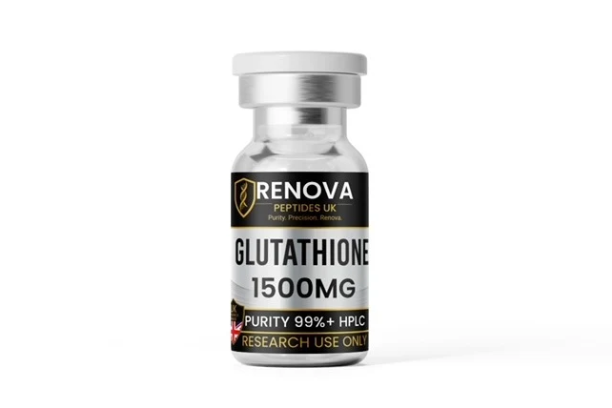
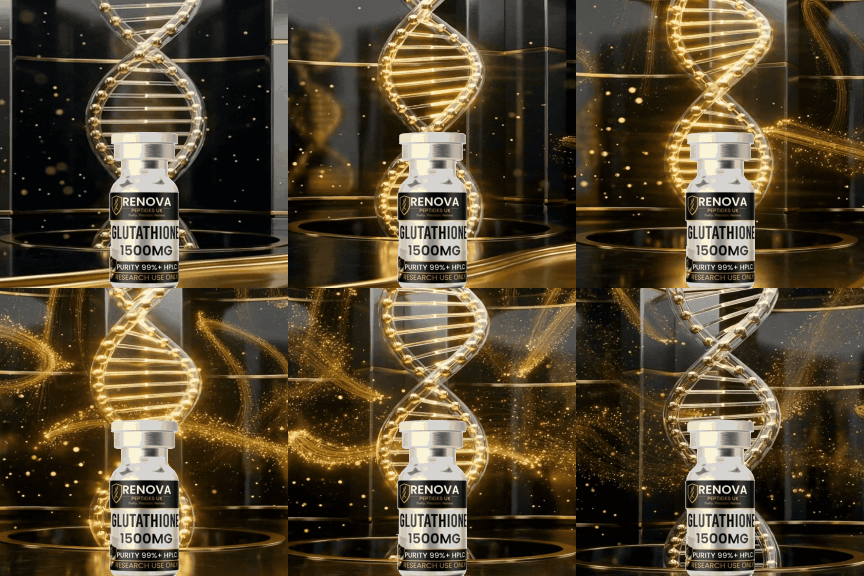
GLUTATHIONE-1500mg
≥99% Purity | –20°C Cold‑Chain Storage |
Same‑Day Dispatch (Before 4pm)
Free UK Shipping Over £100
In stock
Product Overview
Glutathione 1500 mg
Glutathione (GSH) is a naturally occurring tripeptide composed of glutamate, cysteine and glycine. It is widely studied for its involvement in cellular antioxidant systems, redox balance and glutathione-dependent biochemical pathways.
Its role in maintaining cellular thiol balance makes glutathione a useful research tool for investigations into oxidative stress, enzyme activity and cellular responses to experimental challenges. This overview covers the 1500 mg research presentation of reduced L-glutathione. (pmc.ncbi.nlm.nih.gov, pmc.ncbi.nlm.nih.gov)
Areas of Research Interest
Oxidative Stress & Antioxidant Systems
Used in laboratory studies examining peroxide metabolism, antioxidant enzyme activity and cellular responses to oxidative stress.
Cellular Redox Signalling
Investigated in experimental models exploring the balance between reduced and oxidised glutathione, protein thiol status and redox-sensitive signalling. (pubmed.ncbi.nlm.nih.gov)
Glutathione-Dependent Enzyme Activity
Included in biochemical studies involving glutathione peroxidases, glutathione reductase and glutathione transferases.
Cellular Metabolism & Xenobiotic Processing
Explored in research examining glutathione conjugation, the metabolism of foreign compounds and pathways associated with cell proliferation and apoptosis. (sciencedirect.com, pmc.ncbi.nlm.nih.gov)
These research areas highlight glutathione as a versatile compound for laboratory investigations into cellular biochemistry.
Technical Information
Chemical Name: L-Glutathione, reduced
Synonyms: Glutathione, GSH, γ-L-glutamyl-L-cysteinylglycine
Molecular Formula: C₁₀H₁₇N₃O₆S
Molecular Weight: Approximately 307.32 g/mol
Sequence: γ-Glu-Cys-Gly
The glutamate–cysteine linkage involves the γ-carboxyl group of glutamate.
CAS Number: 70-18-8
Classification: Naturally occurring thiol-containing tripeptide
Product Quantity: 1500 mg (1.5 g)
Purity and Physical Form: Refer to the batch-specific certificate of analysis. (sigmaaldrich.com)
Storage Guidelines
Keep the dry material tightly sealed and protected from moisture.
Follow the supplier’s specified storage temperature; some reduced-glutathione research powders specify 2–8°C.
Prepare aqueous solutions fresh where practical, as reduced glutathione can oxidise in solution.
Solution stability depends on pH, temperature, oxygen exposure and laboratory handling conditions. Use validated stability data when storing prepared solutions. (sigmaaldrich.com, sigmaaldrich.com)
Solubility
Reduced L-glutathione is soluble in water. Suitability for aqueous laboratory buffers depends on the concentration, pH and experimental conditions. (sigmaaldrich.com)
References (Research Context Only)
Lu SC. Glutathione synthesis. Biochimica et Biophysica Acta. 2013;1830(5):3143–3153.
Glutathione: Overview of its protective roles, measurement, and biosynthesis.
Glutathione catalysis and the reaction mechanisms of glutathione-dependent enzymes. (pubmed.ncbi.nlm.nih.gov, pmc.ncbi.nlm.nih.gov, sciencedirect.com)
Compliance Notice
For laboratory research use only. Not for human or animal administration.
Reviews
Based on 1,284 reviews
Customers Reviews
I've tried a few different brands, but this one really stands out. The effects are smooth, the taste is great, and it feels clean and consistent every time I use it. Definitely something I'll keep coming back to.

Certificate of Analysis
View Lab ReportRelated products
Frequently Asked Questions