

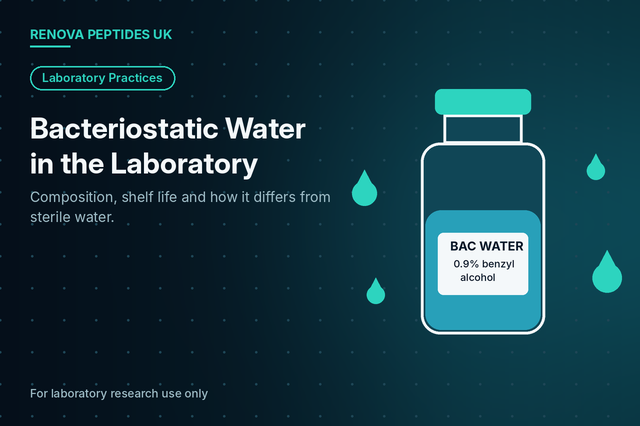
Bacteriostatic water is sterile water that contains 0.9% benzyl alcohol as a preservative. The preservative slows the growth of bacteria, which allows a multi-use vial to be punctured more than once. It is commonly called bac water, and in research laboratories it is used as a diluent for reconstituting lyophilised compounds.
What is bacteriostatic water made of?
Bacteriostatic water is made of two things: sterile water and benzyl alcohol at 0.9%, which is 9 mg per mL. Benzyl alcohol is the bacteriostatic agent. “Bacteriostatic” means it inhibits bacterial growth rather than killing bacteria outright.
What is the difference between bacteriostatic water and sterile water?
| Bacteriostatic water | Sterile water | |
|---|---|---|
| Preservative | 0.9% benzyl alcohol | None |
| Vial type | Multi-use | Usually single-use |
| Risk after opening | Slows bacterial growth | Contamination risk rises once opened |
| Suitable for | Repeated access to the same vial | Applications where preservatives must be avoided |
Because sterile water has no preservative, an opened vial should be treated as single-use. Bacteriostatic water is designed for repeated access but is still not a substitute for good sterile technique.
When should a laboratory avoid bacteriostatic water?
Benzyl alcohol can interfere with some experimental systems. Laboratories should avoid bacteriostatic water, and use preservative-free sterile water or another suitable diluent, where:
- The assay or cell system is sensitive to benzyl alcohol.
- The protocol specifies a preservative-free solvent.
- The experiment is intended to be fully free of additives.
Always follow the protocol or the supplier’s documentation for the compound being handled. Our guide to reconstitution in research settings covers solvent choice in detail.
How long does bacteriostatic water last once opened?
A commonly cited guideline for multi-dose vials of preserved water is to discard them 28 days after first puncture. Check the supplier’s label and your own laboratory procedures, as these take priority. To keep an opened vial usable:
- Wipe the stopper with an alcohol swab before every puncture.
- Use a new sterile needle and syringe each time.
- Label the vial with the date of first opening.
- Store it according to the label instructions.
- Discard it if it becomes cloudy or the stopper is damaged.
More on contamination control is in our guide to laboratory storage and handling.
What should you check when buying bacteriostatic water in the UK?
- The concentration of benzyl alcohol is stated clearly (0.9%).
- The vial size and stopper type suit your workflow. A 10ml vial suits small-scale laboratory work.
- Batch numbers and expiry dates are printed on the label.
- The product is clearly labelled for laboratory use.
- The supplier can provide documentation. See how to evaluate a UK research supplier.
Frequently asked questions
Is bac water the same as bacteriostatic water? Yes. “Bac water” is the common short name.
What is benzyl alcohol water? It is another way of describing bacteriostatic water, which is sterile water with 0.9% benzyl alcohol.
Is bacteriostatic water the same as saline? No. Saline contains sodium chloride, while bacteriostatic water contains benzyl alcohol.
Where can I buy bacteriostatic water in the UK for research? Renova Peptides supplies Bacteriostatic Water 10ml for laboratory use.
For laboratory research use only. Not for human or veterinary use.